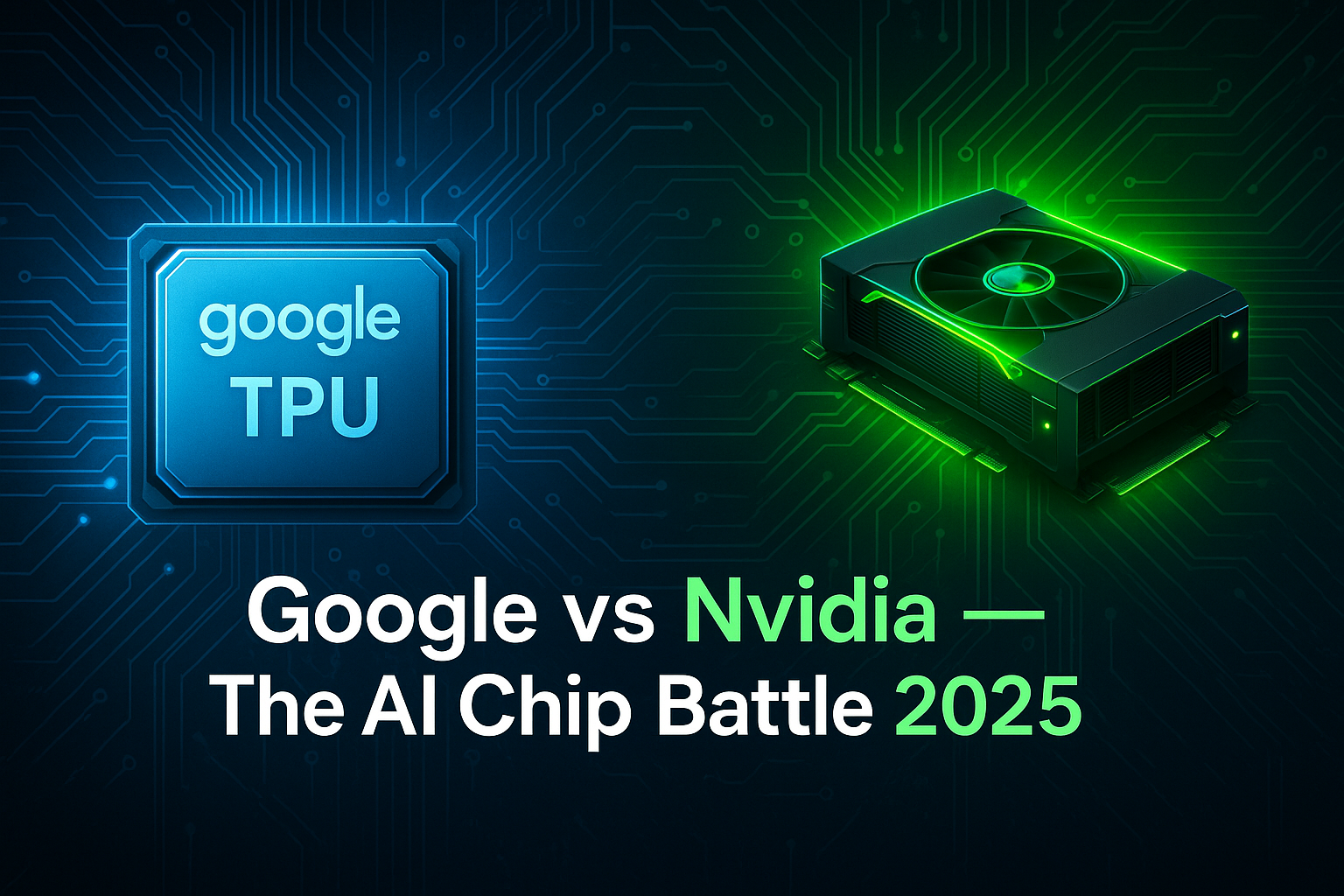
Published: December 02, 2025
Google Enters the AI Chip Business — Nvidia Responds: “Not a Threat, We Welcome It”
The AI hardware industry is witnessing a major shift. Recent reports suggest that Google is preparing to aggressively expand its own AI chip lineup. Meta, one of the world’s largest technology companies, may also begin spending billions on Google’s custom TPUs over the next few years.
These developments briefly pushed Nvidia’s stock lower, as investors worried about rising competition in the AI chip market.
However, Nvidia’s official response surprised everyone.
Nvidia’s Statement: “Our Industry Position Remains Strong”
In a formal announcement, Nvidia made it clear that Google’s growing focus on AI chips is not a threat to the company.
Nvidia stated:
“NVIDIA is still a generation ahead. Every breakthrough in advanced computing continues to run on the Nvidia platform. We have been supplying Google for many years, and we will continue to do so.”
In simple terms, Nvidia believes competition is healthy — but the company maintains that its dominance in AI hardware remains intact.
Why the Meta–Google Deal Is Making Headlines
According to a report by The Information, Meta may start renting large volumes of Google Cloud TPUs as early as next year.
Meta’s massive spending on AI infrastructure could reduce its dependence on Nvidia — a development with major implications for the AI hardware industry.
Experts say that if Meta, one of Nvidia’s biggest customers, shifts even part of its data-center workloads to Google TPUs, the power balance in the AI chip market could change significantly.
Google’s Strategy: Full-Stack AI Control
One of Google’s biggest advantages is its full-stack ecosystem — from AI research to cloud computing, the company controls everything internally.
With the successful launch of Gemini 3 and strong performance reviews that followed, Google’s position in AI has strengthened even further.
A Google spokesperson said:
“Demand for both our custom TPUs and Nvidia GPUs is growing rapidly. We have supported both for years, and we will continue to support both.”
This means Google is not abandoning GPUs — it is simply strengthening its own hardware ecosystem in parallel.
Wall Street Reacts
Nvidia’s stock has seen fluctuations over the past few weeks.
Despite an excellent third-quarter earnings report, new developments from Google and Meta triggered fresh concerns among investors:
- Will the AI chip race still be dominated by a single company?
- Is the AI hardware market heading toward an unsustainable bubble?
Analysts believe the next 12 months will be the most competitive phase in AI history.
Where Is the AI Chip Race Heading?
Here’s the current landscape:
- Google – expanding its custom TPU ecosystem and controlling the full AI stack
- Nvidia – the strongest GPU platform and industry standard
- Meta – one of the biggest AI hardware buyers, now exploring alternatives
- Microsoft & Amazon – accelerating development of their own AI chip projects
The AI hardware race is no longer just about performance — it has become a battle of supply chain strength, cost efficiency, and ecosystem dominance.
Conclusion
Google’s deeper push into AI chip development signals a future of increased competition.
Nvidia, however, still remains the backbone of global AI computing.
While short-term market volatility is expected, the broader picture is clear:
The AI hardware race has entered its fastest and most exciting phase yet — and the coming years will reshape the entire industry.
🛑 Disclaimer
This article is for informational and educational purposes only. Always consult a professional financial advisor before making any investment decisions.

Sumit Ghatala is a stock market researcher and financial content writer with over 8 years of experience tracking Indian equity markets, corporate earnings, and sectoral trends. He focuses on analysing company fundamentals, quarterly results, and broader market movements to provide readers with clear and structured insights.
Sumit’s work is aimed at simplifying complex market data and helping retail investors understand risks, opportunities, and long-term perspectives through balanced and reader-friendly analysis.